May Kasahara
The Wind-Up Bird ChronicleMay Kasahara is Toru Okada’s sixteen-year-old neighbor, a sharp observer whose playful provocations draw her into the central emotional and symbolic spaces of his story. She becomes more than a companion across the alley: she tests the limits of Okada’s endurance, later explains that she tried to imagine his fear while he was trapped, and ultimately meets him again as a young woman still deciding what kind of life to choose.
Identity and Introduction
Okada first sees May in the garden across the alley, a small girl with a ponytail, amber-framed sunglasses, a light-blue sleeveless shirt, and one hand resting on a low bamboo gate. When they meet again, she identifies herself as May Kasahara and explains that May is the name of the month. She is sixteen, newly into her first year of high school. The name and age establish a voice that is both youthful and unusually willing to speak directly to an adult, whom she calls Mr. Wind-Up Bird.
Their early acquaintance is organized around the immediate geography of the alley and garden. May watches the vicinity from home, sunbathes in the yard, and knows about the well; when she asks whether Okada wants to see it, she opens a passage from casual neighborly contact toward one of the novel’s most consequential places. On later meetings she wears the same light-blue Adidas shirt and short pants and walks with a slight limp. Her recognizable presence, at once ordinary and slightly enigmatic, links the everyday garden to the hidden depths of the well.
Work, Wit, and View of Adulthood
May invites Okada to accompany her to work because the job is done in pairs and she would rather have someone she knows than a stranger asking personal questions. The work is a peculiar, methodical survey: for three hours by a subway entrance near the Wako Building, they classify passing men’s hair as A, B, or C according to degree of baldness. May calls out each category quickly and accurately while Okada records it. The comic precision of the task becomes a way for her to turn ordinary public observation into a private system of measurement.
She gives the counting a darker interpretation. May speculates that fear of baldness comes from its seeming to announce the wearing away of life, a step toward death. When Okada describes her outlook as pessimistic, she insists that she is only sixteen and knows little of the world, but argues that adults who are not pessimistic are fools. Her bleakness is not simply a pose of adolescent cynicism: she looks for mortality in a familiar change of appearance and refuses the reassurance that age might make it easier to ignore.
Friendship with Okada and the Well
May’s attachment to Okada takes the form of familiarity, dependence, curiosity, and deliberate testing. When he needs someone to call Kumiko’s office, he goes to May and asks her to make the call in his place. The request shows how their acquaintance has become useful in moments when he cannot manage a direct approach himself. Elsewhere, she calls to him from the garden while he is down in the well, and the distance between her voice above and his position below makes their neighborly connection part of the scene of confinement.
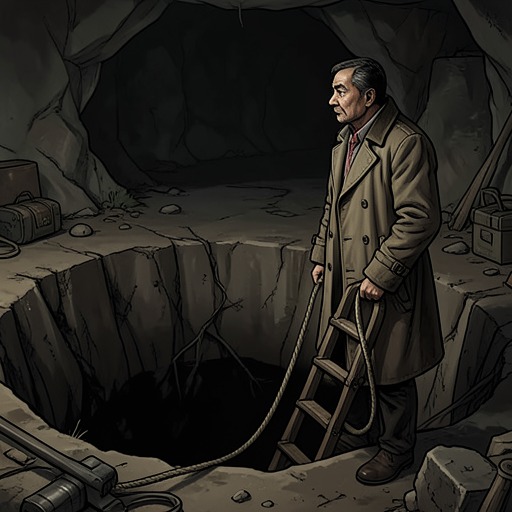
May admits that she secretly pulled up the ladder after Okada descended. She says that she meant to frighten and torment him, to discover how long it would take before he became confused and lost his sense of his world. She says she planned to rescue him before the end, and did not intend to let him die. Her actions nevertheless leave him without a way out, with May the only person who knows he is there. The episode exposes the danger in her playfulness: she treats another person’s helplessness as a test, while retaining the power to decide when the test will stop.
Her later explanation makes the episode more than a prank. While Okada remained below, May says, she stayed outside, sunbathing and thinking about his hunger, fear, and approach to death. Imagining his experience gave her an unusually clear sense of what he was feeling and, in her account, brought her close to him. The contradiction is central to their relationship: she puts him in danger in order to approach his experience, yet maintains that she would have saved him. Her empathy is real, but it develops through a disturbing act of control rather than through uncomplicated care.
May also reports that spending the first hours alone in the dark did not frighten her much. As time passed, however, she felt less certain of who she was and sensed something inside her growing, as though it might eventually break her apart. The account parallels Okada’s encounter with the well without making their experiences identical: both associate darkness and confinement with a destabilization of the self. May’s story shows that the well’s meaning extends beyond the person physically trapped in it; her imaginative participation carries its own psychological cost.
Loss, Guilt, and a Return to School
May eventually tells Okada that a boy died and that she caused his death accidentally. She describes their play as a game and says that she had not meant to kill him. Her disclosure connects her fascination with limits and danger to an earlier experience in which play crossed into irreversible consequence. The evidence does not make the accident a simple explanation for her behavior, but it gives her provocations a history of loss and guilt: she knows that an action intended as play can end in death.
She says that meeting Okada finally made her decide to go back to school. Her decision suggests that their conversations have affected her beyond the immediate drama of the well. Yet her eventual path is not presented as a straight return to ordinary life. In a later message she describes withdrawing at home from March into April, reading and watching television while repeatedly thinking about Okada and wondering what had happened to him, Kumiko, the Kano sisters, the cat, and the mark on his cheek. She watches the alley from her room rather than seeking him out, aware that another meeting could repeat the intensity of the previous summer.
In that same communication, May recounts that during their earlier conversations she had privately worried about the possibility that Okada might force himself on her. She recognizes that she might have become confused while trying to explain why such an act would be wrong. The disclosure does not describe an assault; it reveals that her apparent ease around an older man coexisted with apprehension about vulnerability and unequal power. It also gives her earlier invitation to spend time together a less straightforward emotional context: closeness and fear were present at once.
Distance, Connection, and the Ending
In later messages addressed to Mr. Wind-Up Bird, May writes about waking alone far from other people and becoming frightened by uncertainty about the future. To steady herself, she lists the people and things that connect her to the world: Okada, the alley, the well, the persimmon tree, wigs she has made with her own hands, and fragments of memory about the boy. These are not interchangeable items. The list binds a person who feels isolated to places, work, relationships, and a remembered loss, making connection an active practice rather than a certainty she can take for granted.
The final meeting takes place beside a pond capped with ice. May, now seventeen, has taken time away from work to see Okada after a train accident delayed his visit by a day. She is sorry about the delay, but the scene also shows her as a person with her own work and a developing independence. She says she may want to return to school after more time, or may not; she might marry, she jokes, then withdraws the suggestion. For now, she wants time to think about what she wants and where she wants to go. Her future remains open rather than resolved by the earlier declaration that Okada inspired her to return to school.
As they walk through the woods, May removes one glove and puts her hand in Okada’s pocket. The gesture recalls Kumiko’s former habit of sharing a pocket with him in winter, creating a quiet echo between the two relationships without suggesting that May simply replaces his absent wife. At the station, after they have taken a bus into town and eaten pizza, May kisses Okada on the cheek where his mark had been. She asks him to call out to her and the Duck people if anything happens to him. The farewell leaves their bond intimate but not defined by a settled future: May remains a young person in motion, connected to Okada through memory, care, and the possibility of answering his call.